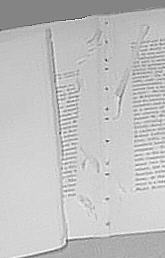
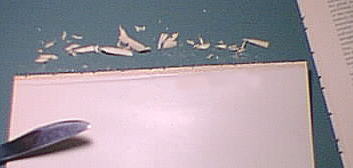
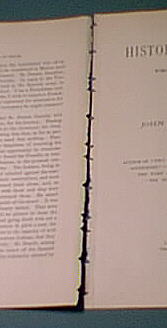
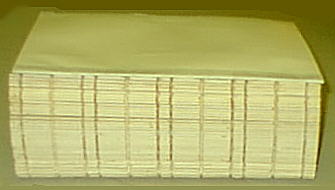

disbound signatures before cleaning an inserted 'plate' 2 page sheet with weakened fold cleaning a 'plate' with palet knife separated 2 page sheet due to failed fold restored signatures ready for sewing

Michael Keller / Bookbinding and Restoration

Buckram Grove Press


Revised September, 2024


Home      Printables      Gallery      Links      Faqs       Contact


A complete restoration in detail

(Part One) Disbinding; Cleaning; Guarding; Repairs

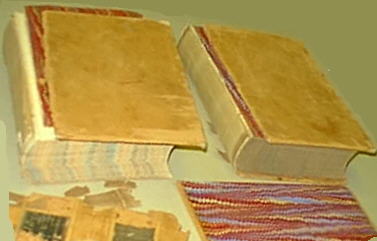
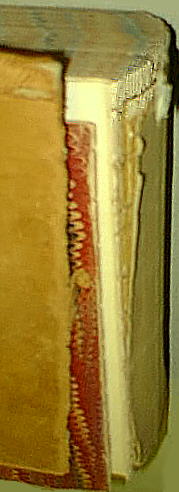
This two volume set is a good example of typical full leather, mid 19th Century bindings where the leather has deteriorated over time - the hinges have failed, the dry leather has become powdery and not much of the original spines have survived.

all extant pieces before restoration

The text-block(s) has remained more or less intact, but the weak points include:


      • the low quality original thread used in sewing the sections ('signatures') together;

      • the cost saving minimal sewing methods commonly employed,

      • and the animal-based glues which have since become dry and brittle.

detail of spine condition


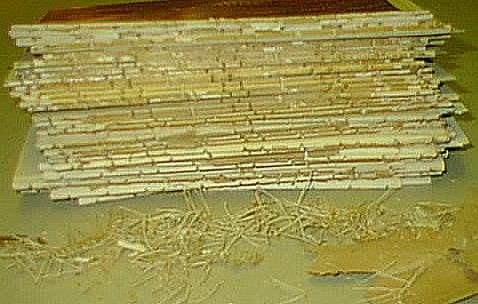
The first step is to disbind all of the signatures from the text-blocks.


Once separated, the signatures are ready for individual cleaning...


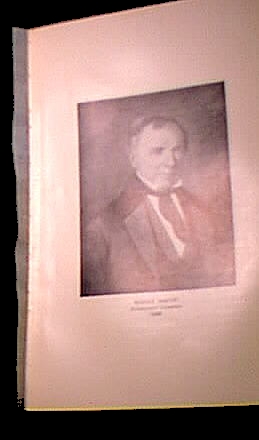
An important part of the cleaning process is the treatment of any 'plates'

within the text... 'Plates' refer to any illustrations printed on special paper -

as single sheets. Since they, by definition, cannot be sewn in with the rest

of the printed pages, they must be added individually by applying

a thin bead of adhesive along the spine-edge of each sheet ['tipping-in']

and simply sticking the sheets in between the appropriate pages.

Obviously not a very secure method of permanent attachment

- this accounts for the fairly common problem of loose plates within older books.

Each plate must be carefully detached
and cleaned of all adhesive residues...


...along with the adjoining text pages.


A strip of archival paper (in this case mulberry paper)
is then attached to the spine edge of each plate ['guarding'],
and used to permanently secure the plate to its signature.

The plate can now be, in effect, sewn in as part of the signature and is thus

able to open flat with all the rest of the text pages, without putting any direct strain

on the adhesive or guarding paper.


The next step is to assess each signature for any tears,
tattered edges, or signs of weakness in the fold area.

A variety of archival tissues and papers are used to correct these problems.


In the event of a complete separation at the fold,
the same 'guarding' technique, employing strips of repair
tissue or paper, is used to rejoin the leaves back to a single folded sheet.


After cleaning and repair, the restored signatures
are ready for hand sewing onto cloth tapes or cord.


CONTINUED IN...

A complete restoration in detail (Part Two)

Sewing; Backing; Split Boards; Leather Preparation, etc.


Back to Gallery index